
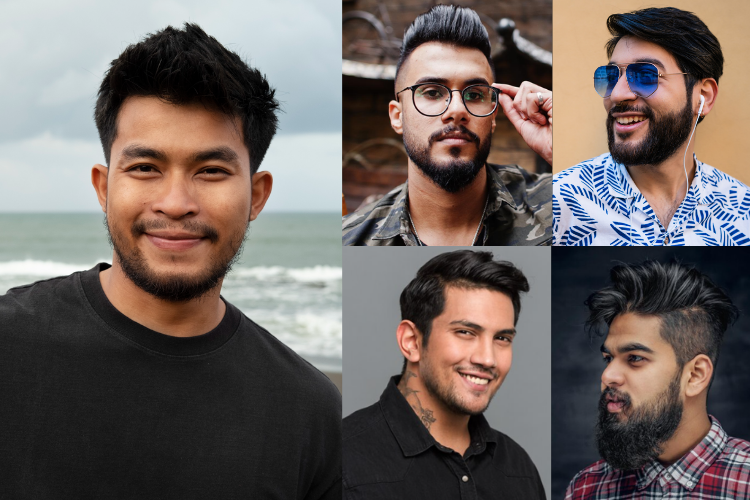
Asian beard styles work best when they’re chosen around genetics, not around what looks good on someone else’s face. Facial hair for Asian men often grows in patches, comes in finer than expected, or takes longer to fill out than the thick, even beards seen on other ethnicities, and fighting that natural pattern is usually what makes a beard look messy instead of intentional.
This guide breaks down the best asian beard styles for every face shape, growth pattern, and hair texture, from goatees and short beards to full and south asian beard styles. It also covers the genetics behind Asian facial hair, how to manage patchy growth, and the care routine that keeps straight, fine hair looking sharp instead of flat.
Quick Answer: For most Asian men with patchy or uneven growth, a goatee or short beard gives the cleanest, most reliable result. For denser South Asian growth, a full beard or sharply faded beard holds shape well. For fine, straight East Asian hair, stubble or a thin beard style hides sparse areas better than anything longer.
- 🥇 Best for patchy growth: Goatee Asian Beard
- 💪 Best for denser growth: South Asian Full Beard
- ⚡ Best low-maintenance pick: East Asian Stubble
- 👤 Best for round faces: Long Asian Beard
- 🕰️ Best traditional style: Old Asian Beard
18Asian beard styles covered
2–8 moTypical time to see full growth potential
6Face shapes matched to a style
28Average age Asian men hit full beard potential
This guide sits within our full beard styles for men collection, so there’s a matching guide here no matter your hair type or face shape.
What’s in This Guide
- What Makes Asian Beard Growth Different
- How Asian Beard Genetics Work
- Can Asian Men Have Beards?
- Face Shape Guide
- 18 Best Asian Beard Styles
- Style Comparison Table
- Fixing a Patchy Asian Beard
- Asian Beard Care Routine
- Is a Beard Transplant Worth It?
- Tools You Need
- Common Mistakes
- FAQs
🧬 What Makes Asian Beard Growth Different?
Asian beard growth differs from other ethnicities mainly in density, texture, and coverage pattern. East Asian men, including those with Chinese, Japanese, and Korean backgrounds, tend to have fewer hair follicles per square centimeter than men of European or Middle Eastern descent, which creates the appearance of a thinner or patchier beard even when every individual hair is perfectly healthy.
South Asian men from India, Pakistan, and Bangladesh often grow denser beards that resemble Middle Eastern patterns much more closely than East Asian growth does. The difference comes down to inherited genetics rather than hormones. Testosterone plays a role, but most of the variation between individuals traces back to family traits passed down through generations.
Texture is the other major factor. Asian facial hair is often straighter and lies flatter against the skin instead of curling outward, which makes thinner beards look even thinner since the hair creates less visual volume. That same straightness is also an advantage, since flat, straight hair is easier to shape and holds a cleaner line than the curlier, higher-volume hair seen in other popular beard styles.
🔬 How Do Asian Beard Genetics Work?
Asian beard genetics decide how much facial hair grows and exactly where it shows up on the face. The EDAR gene, more common in East Asian populations, directly affects hair thickness and follicle density, and the same gene also shapes sweat glands and tooth structure, which shows how deeply it’s tied to overall physical traits rather than just facial hair.
Family history is the single best predictor of beard potential. Beards that ran full on a father or grandfather usually signal the genetics for full coverage, while a family line of light or patchy growth tends to repeat itself. Age is the other major variable, since many Asian men don’t see their true beard potential until their late twenties or early thirties, a pattern similar to what shows up in scruffy beard growth.
Real coverage on the cheeks frequently doesn’t appear until around age 28, with growth limited mostly to the chin and upper lip before that. Patience does more for an Asian beard than any product on the market.
❓ Can Asian Men Have Beards?
Yes, Asian men can grow beards, though genetics control the density, thickness, and evenness of the growth. Follicle count and hormone sensitivity vary from person to person, so two Asian men from the same region can end up with completely different beard potential by their late twenties.
The real work is choosing asian beard styles that fit your specific growth pattern instead of forcing a look your genetics can’t support. A well-shaped goatee, short beard, or clean stubble can look every bit as intentional and sharp as a full beard, usually with far less daily upkeep.
👤 Which Face Shape Suits Which Asian Beard Style?
Face shape narrows down the many asian beard styles fast. Use this table as a starting point, then check the “Best For Which Face Shape” note under each style below.
| Face Shape | Why It Works | Best Style |
|---|---|---|
| Round | Adds vertical length and chin definition | Goatee or chin beard |
| Square | Softens strong jaw angles | Short or full beard |
| Oval | Balanced proportions suit almost any style | Any variation |
| Long / Oblong | Fuller sides avoid lengthening the face further | Wispy or stubble beard |
| Heart / Triangle | Chin volume balances a wider forehead | Full or thin chin beard |
| Diamond | Adds width at the jaw and chin | Beard and mustache combo |
✂️ Best Asian Beard Styles
The right beard style works with natural growth instead of fighting it. Below are the best asian beard styles, from goatees and short cuts to full and south asian beard styles, each with a face-shape match and a maintenance note.
1. Goatee Asian Beard Styles
The goatee concentrates growth on the chin and around the mouth, usually the strongest areas on an Asian face, while the cheeks stay clean-shaven. Letting the chin hair reach about half an inch gives enough length to shape without needing any cheek coverage at all, which makes it one of the most forgiving goatee beard styles for uneven growth.
Plenty of men wear a goatee for years before their cheeks ever catch up, and the defined chin line often looks sharper than stubble ever manages to.
Best For Which Face Shape: Round and square faces, since the chin focus adds length and sharpens the jawline.
Maintenance: Low · Growth time: 3-5 weeks
2. Short Asian Beard Styles
A short beard holds a uniform length across the whole face, typically three to ten millimeters, and that consistency is exactly what hides patchiness better than any longer style. A trimmer with a guard keeps the coverage even, and rotating between this and other short beard styles is common as growth cycles change.
Sitting around five millimeters reads as intentional rather than a missed shave, and it only takes a few minutes of upkeep every other day.
Best For Which Face Shape: Square and oval faces, since the uniform length keeps proportions balanced.
Maintenance: Low · Growth time: 2-4 weeks
3. Asian Beard and Mustache Styles
Pairing a mustache with a chin beard builds a classic frame around the mouth that plenty of Asian men can wear easily. The mustache connects to the beard at the corners of the mouth, and keeping the cheeks clean or barely stubbled puts all the attention on that central shape, echoing classic looks like the handlebar mustache.
This combination shows up repeatedly in Chinese and Japanese historical art, so the style has centuries of precedent behind it. It flatters most face types and needs only moderate upkeep.
Best For Which Face Shape: Diamond and oval faces, since the mouth-framing shape balances angular features.
Maintenance: Moderate · Growth time: 4-6 weeks
4. Thin Asian Beard Styles
A thin beard leans into sparse growth instead of hiding it, letting every part of the face grow to the same length even where follicles are fewer. Sharp, clean edges along the cheeks and neck are what turn a thin beard into a deliberate style instead of an accident, an approach that overlaps closely with patchy beard styles.
Korean actors and musicians wear this look on screen often, and it adds visible maturity to softer, younger-looking features without overwhelming them.
Best For Which Face Shape: Heart and triangle faces, since the light chin coverage balances a wider forehead.
Maintenance: Low · Growth time: 3-4 weeks
5. Wispy Asian Beard Styles
The wispy beard leaves longer, finer hairs to grow out naturally with almost no heavy shaping, and it works best on straight, flat-lying hair. It’s a relaxed, understated look suited to casual settings, but over-trimming quickly makes it read as patchy instead of intentionally light. A lightweight product along the lines of what beard butter does keeps the hair soft without adding weight.
A weekly trim and a light beard oil keep the strands soft and the shape looking natural instead of neglected.
Best For Which Face Shape: Long and oblong faces, since the loose, low-volume texture avoids adding extra length.
Maintenance: Low · Growth time: 6-8 weeks
6. Long Asian Beard Styles
A long Asian beard needs patience and the genetics to support fuller growth, with at least two inches of length required before it starts filling in visually. Straight Asian hair tends to hang neatly at these longer lengths, giving a sleek finish that curlier beards can’t replicate, which is why men exploring long beard styles often find Asian hair texture especially well suited to the look.
Growing it out typically takes around eight months before it stops looking neglected and starts looking deliberate, but the sleek, straight payoff makes the wait worth it.
Best For Which Face Shape: Round and square faces, since the added length elongates and softens the jaw.
Maintenance: High · Growth time: 6-8 months
7. Full Beard Asian Beard Styles
The full beard covers the cheeks, chin, and jaw and connects seamlessly to the mustache with no gaps. Not every Asian man has the genetics for full coverage, but South Asian men and East Asian men with mixed heritage tend to have the strongest odds, and the result lines up closely with classic full beard styles seen worldwide.
Letting everything grow untouched for three months is the most reliable way to find out your true coverage potential before committing fully to the style.
Best For Which Face Shape: Oval and diamond faces, since full coverage balances proportions evenly all around.
Maintenance: High · Growth time: 2-3 months
8. Old Asian Beard Styles
The traditional old Asian beard grows long and thin from the chin, sometimes extending several inches past the chest, echoing historical depictions of scholars, monks, and elders. The cheeks stay bare while the chin hair is left to grow freely downward, an aesthetic that shares roots with styles like the imperial beard.
This look is still worn today by older men who’ve chosen never to trim their chin growth, letting decades of length become the defining feature of their appearance.
Best For Which Face Shape: Round and oval faces, since the narrow, downward growth adds strong vertical length.
Maintenance: Low, but requires years of growth · Growth time: 1+ years
9. East Asian Stubble
Stubble suits men who want visible facial hair without committing to a full beard, kept between one and three millimeters with a trimmer. That short length adds shadow and definition while staying clean enough for most workplaces, and many men rotate between this and other stubble beard styles.
East Asian stubble tends to read cleaner than other ethnicities because the hair grows straighter and lies flatter, producing a five o’clock shadow that stays neat all day.
Best For Which Face Shape: Oblong and long faces, since the light, even shadow doesn’t add extra length.
Maintenance: Very low · Growth time: 3-5 days
10. South Asian Beard Styles
South Asian beard styles typically start from a denser, fuller growth pattern that sits closer to Middle Eastern facial hair. Men from India, Pakistan, and Bangladesh often have the coverage to support fuller beards, sharp faded beards, and thicker mustache-forward looks with far less patchiness than East Asian growth tends to show.
That density opens up bolder shapes, from a full beard to a sharply lined faded beard, without the same worry about thin patches showing through.
Best For Which Face Shape: Square and rectangular faces, since denser growth holds sharp, structured lines well.
Maintenance: Moderate to high · Growth time: 4-6 weeks
11. Asian Chin Strap Beard Styles
The chin strap traces a narrow line of hair along the jaw from sideburn to sideburn, leaving the cheeks and chin bare or nearly bare. Since it relies on jawline growth rather than cheek density, it sidesteps the exact area where Asian beard growth tends to run thinnest, making it one of the more forgiving chin strap beard options for uneven growth.
Keeping the line crisp and thin is what separates a sharp chin strap from a look that reads unfinished, so regular edging matters more here than length.
Best For Which Face Shape: Long and oval faces, since the horizontal line adds width without extra length.
Maintenance: Moderate · Growth time: 3-4 weeks
12. Asian Balbo Beard Styles
The Balbo disconnects the mustache from a shaped, floating chin beard, with the cheeks kept clean throughout. Straight Asian hair holds this kind of precise, sculpted line especially well, since it doesn’t fight the razor the way curlier hair can, and the result sits close to the polished shape covered in our Balbo beard styles guide.
It’s a deliberate, detail-heavy style that rewards regular trimming but gives a sharp, structured look that works well for coverage that’s strong on the chin but lighter on the cheeks.
Best For Which Face Shape: Round faces, since the disconnected shape adds definition without bulk.
Maintenance: High · Growth time: 4-5 weeks
13. Asian Van Dyke Beard Styles
The Van Dyke pairs a pointed chin beard with a separate, styled mustache, skipping the cheeks entirely. It’s a strong option for men whose growth is concentrated on the chin and upper lip, which is a common pattern in Asian beard growth, and it channels the same sharp, artistic shape found in the classic Van Dyke beard.
The pointed chin draws the eye downward and adds a vintage, deliberate edge that stands out from more common goatee shapes.
Best For Which Face Shape: Oval and triangular faces, since the pointed chin adds length and balance.
Maintenance: Moderate to high · Growth time: 4-6 weeks
14. Curly or Wavy Asian Beard Styles
Not every Asian beard grows straight, and men with wavier or curlier facial hair can lean into that texture instead of fighting it for extra visual volume. Letting the length grow slightly longer than a typical short beard gives the natural wave room to show, which helps thinner areas look fuller, echoing the texture-first approach in our curly beard styles guide.
Regular conditioning keeps the curl pattern defined rather than frizzy, especially since finer, wavier hair dries out faster than straight hair.
Best For Which Face Shape: Square and diamond faces, since the added texture softens sharp angles.
Maintenance: Moderate · Growth time: 4-6 weeks
15. Asian Beard Without Mustache
Skipping the mustache and keeping hair only on the chin and jaw creates a clean, modern shape that suits Asian men whose mustache growth comes in thinner than the rest of their beard, a genetic pattern that’s fairly common. The bare upper lip draws attention to the jawline instead, which lines up with the approach detailed in our beard without mustache guide.
It’s a low-fuss option that avoids the extra shaping a full mustache requires while still giving real definition to the lower face.
Best For Which Face Shape: Round and oval faces, since the chin-only focus adds length without extra bulk.
Maintenance: Low · Growth time: 3-4 weeks
16. Faded Asian Beard Styles
A faded beard blends shorter hair near the sideburns into longer growth toward the chin, creating a barbershop-sharp gradient rather than a hard line. It pairs especially well with a fresh haircut and tends to look cleanest on denser South Asian growth patterns, though a light fade also works on East Asian stubble, in line with our faded beard styles guide.
The gradual blend hides the transition between denser and thinner areas, which makes it a useful option for uneven growth as well as a styling choice.
Best For Which Face Shape: Square and rectangular faces, since the sharp taper adds structure to strong angles.
Maintenance: High · Growth time: 3-5 weeks
17. Asian Circle Beard Styles
The circle beard connects a rounded mustache to a small chin beard, forming a continuous loop around the mouth with the cheeks left bare. It’s a compact style that needs only chin and upper-lip growth, both common strong points for Asian facial hair, and it mirrors the shape covered in our circle beard styles guide.
Straight hair holds the tight, rounded lines of this shape cleanly, which is part of why it reads so precise once properly trimmed.
Best For Which Face Shape: Oval and diamond faces, since the compact loop keeps proportions balanced.
Maintenance: Moderate · Growth time: 3-4 weeks
18. Asian Soul Patch Beard Styles
A soul patch is a small tuft of hair kept just below the lower lip, with everything else shaved clean. It’s the lowest-commitment option on this list and works even for men with very limited beard growth, since it needs only a small patch of hair to look finished, similar to the minimal approach in our soul patch beard styles guide.
It’s a subtle style rather than a bold one, best suited to men who want a hint of facial hair without shaping an entire beard.
Best For Which Face Shape: Round and heart faces, since the small chin accent adds definition without weight.
Maintenance: Low · Growth time: 1-2 weeks
📊 Asian Beard Styles Comparison Table
A side-by-side view of maintenance, growth time, and best face shape across the most requested asian beard styles.
| Style | Maintenance | Growth Time | Best Face Shape |
|---|---|---|---|
| Goatee | Low | 3-5 weeks | Round, square |
| Short Beard | Low | 2-4 weeks | Square, oval |
| Full Beard | High | 2-3 months | Oval, diamond |
| Stubble | Very low | 3-5 days | Oblong, long |
| South Asian Full | Moderate-high | 4-6 weeks | Square, rectangular |
| Long Beard | High | 6-8 months | Round, square |
| Chin Strap | Moderate | 3-4 weeks | Long, oval |
| Soul Patch | Low | 1-2 weeks | Round, heart |
🎯 Best Asian Beard Style By Situation
Patchy or uneven growth → Goatee or chin strap. Both avoid the cheeks entirely, which is where Asian beard growth tends to run thinnest.
Professional or office setting → Short beard or East Asian stubble. Clean, uniform, and quick to maintain between trims.
Dense South Asian growth → Full beard or faded beard. Enough coverage to support sharp lines and bolder shapes.
Want maximum length → Long Asian beard. Needs the most patience but suits straight hair especially well.
Minimal commitment → Soul patch or thin beard. Small, low-maintenance styles that still read as intentional.
Traditional or statement look → Old Asian beard or beard and mustache combo. Rooted in centuries of East Asian style history.
🩹 How to Deal With a Patchy Asian Beard
A patchy Asian beard frustrates plenty of men, but a few approaches consistently help. Start by choosing a style built around your thin spots instead of against them. If the cheeks aren’t filling in, a goatee or chin strap removes those areas from the equation entirely.
Growing the beard longer can also visually fill in patches, since hair from denser areas overlaps thinner spots once it reaches enough length. Give at least two to three months of uninterrupted growth before deciding a style won’t work.
Minoxidil, the active ingredient in Rogaine, has helped some men thicken patchy areas. It was designed for scalp hair, but many users report thicker facial hair after several months of consistent application. Results vary by individual, and any gains typically reverse if you stop using it.
Six months of minoxidil applied to the cheeks is a common timeline before noticeable improvement shows. Full density rarely arrives, but coverage often becomes dense enough to support a short beard. Pairing the routine with a beard balm during this stage helps enhance fullness and softness as new growth comes in.
🧴 How to Take Care of an Asian Beard
Asian beard care comes down to keeping the hair soft, the skin healthy, and the shape clean. The straight texture common in Asian facial hair is prone to looking flat or greasy without the right routine.
- Wash 2-3 times a week. Use a beard-specific wash or mild shampoo. Daily washing strips the natural oils that keep straight hair soft, so less is more here.
- Pat dry, don’t rub. Rubbing a towel against finer Asian beard hair causes more breakage than patting it dry gently.
- Apply beard oil daily. A few drops worked through the hair and into the skin prevents dryness and adds a light, natural shine. Look for jojoba or argan bases, which absorb without heavy residue.
- Layer beard butter for extra hold. Pairing oil with the right beard butter locks in softness and adds light manageability, especially for longer styles.
- Comb or brush every morning. A boar bristle brush suits shorter beards, while a wide-tooth comb works better on longer lengths. This daily habit trains straight hair to lie the way you want.
💉 Is an Asian Beard Transplant Worth It?
An Asian beard transplant relocates hair follicles from the scalp to the face, creating permanent coverage in spots that don’t grow hair naturally. The procedure typically costs between $5,000 and $15,000, depending on graft count and location.
Surgeons in South Korea and Thailand perform a high volume of these procedures on Asian patients and have specific experience matching results to Asian facial features. Transplanted hair initially behaves like scalp hair, growing faster and needing more frequent trims until it adapts to its new location.
Recovery takes about two weeks before resuming normal activity. The transplanted hairs shed after roughly a month, which is expected, and new growth begins around the third month, with full results visible between twelve and eighteen months post-procedure.
It’s a permanent, effective option for men who’ve struggled with patchy growth long-term and can afford the cost, though it isn’t the right call for everyone.
🧰 Tools You Need for Asian Beard Styles
- Precision trimmer. Essential for outlining goatees, chin straps, and Balbo-style shapes with sharp, even edges. See our tested best beard trimmers.
- Fine-tooth comb. Straight Asian hair responds better to a finer comb than the wide-tooth combs suited to curlier textures. Check our best beard comb picks.
- Lightweight beard oil. Jojoba or argan-based oils absorb without weighing down fine, straight hair. Our best beard oils guide has top picks.
- Razor or shavette. For clean cheek and neck lines on goatee, chin strap, and Van Dyke styles.
- Beard balm. Useful for holding shape on longer or wispy styles without the greasy look heavier waxes can leave. See the best beard balms.
- Well-lit mirror. Sharp-lined styles like the Van Dyke and circle beard need close symmetry checks that are easy to miss in poor light.
⚠️ Common Mistakes With Asian Beard Styles
- Choosing a style that fights your growth pattern. Forcing a full beard over patchy cheeks looks less intentional than a goatee or chin strap built around your strongest areas.
- Over-washing. Straight, fine hair dries out fast; washing daily strips the oils that keep it soft and manageable.
- Giving up on growth too early. Many patchy areas fill in with two to three more months of uninterrupted growth.
- Using heavy products. Thick waxes and balms weigh down straight hair and make it look greasy rather than styled.
- Skipping the neckline. Straight hair shows an undefined neckline more obviously than curlier textures, so regular edging matters.
Make These Asian Beard Styles Your Own
Choosing among asian beard styles comes down to understanding your genetics and building a routine and shape around them rather than chasing a look your growth pattern can’t support. Not every man can grow a full beard, but nearly every man can find a style, from a sharp goatee to a full south asian beard, that looks deliberate and polished.
Patience and realistic expectations do more here than any product. Once the style matches the growth pattern, the results stop looking like a work in progress and start looking intentional. For maintaining softness and shape day to day, using the best beard comb for your hair type makes a noticeable difference.
FAQs
What beard styles suit Asian men best?
Goatees, short beards, and chin straps tend to suit Asian men best because they concentrate hair on the chin and jaw, the areas where Asian beard growth is usually strongest, while avoiding patchier cheeks. Men with denser South Asian growth also have the coverage to wear full or faded beards well.
Can Asian men have beards?
Yes, Asian men can grow beards, though genetics affect the density, thickness, and evenness of growth more than for some other ethnicities. Follicle count and hormone sensitivity vary widely, so choosing a style that fits your specific growth pattern matters more than trying to copy someone else’s beard.
Why do Asian men struggle to grow beards?
Some Asian men struggle to grow full beards because of genetic factors that reduce the number of hair follicles on the face. East Asian populations carry gene variants like EDAR that affect hair density and thickness, meaning lower follicle counts even when the existing hair itself is perfectly healthy.
At what age do Asian men grow full beards?
Asian men typically reach their full beard potential between their mid-twenties and early thirties, with many not seeing complete coverage until age 28 or later. Facial hair continues developing through a man’s twenties as hormone levels stabilize.
What is the best beard style for patchy Asian growth?
A goatee or chin beard is the best style for patchy Asian growth, since both focus on the strongest growth areas and avoid the cheeks entirely. Short stubble kept at three to five millimeters also hides thin spots by creating uniform shadow across the face.
Does minoxidil work for Asian beard growth?
Minoxidil works for Asian beard growth in many cases, though results vary by individual. It increases blood flow to hair follicles and can stimulate dormant ones to produce visible hair, usually after six to twelve months of twice-daily application.
How do South Asian beards differ from East Asian beards?
South Asian beards tend to be denser and fuller, closer to Middle Eastern growth patterns, while East Asian beards from China, Japan, and Korea are typically sparser with fewer follicles per square inch. This difference shapes which styles look most natural on each growth pattern.
How often should you trim an Asian beard?
An Asian beard should be trimmed every one to two weeks to hold its shape, while shorter styles like stubble need trimming every two to three days. Straight hair shows uneven growth more clearly than curly hair, so regular trims matter more here.
Can you make an Asian beard grow faster?
You can’t meaningfully speed up Asian beard growth beyond its natural rate of about half an inch per month. Good nutrition, sleep, and lower stress support healthy growth but won’t accelerate the underlying rate.
Is an Asian beard transplant permanent?
Yes, an Asian beard transplant is permanent, since the procedure relocates living follicles from the scalp to the face where they continue producing hair for life. The transplanted hair may grow faster at first before settling into a normal facial hair growth pattern.
Further Reading
- Best Beard Care Products: Oils, Butters, Balms, Wax & More
- Beard Grooming Tools: What You Need & How to Use Them
- How to Groom a Beard: The Complete Routine
- How to Grow a Beard? Faster Growth, Stages, and Fixes
- Common Beard Problems and How to Fix Them
- Mustache Styles and Grooming: The Complete Guide for Men

I’m a regular guy who got way too into beard care and started writing it all down. Everything here comes from my own experience with my own beard, not from a brand brief.